ODS 12 > ibi
Ibi’s Harvest Basket
No more food waste
Food waste is one of the world's greatest sustainability challenges. Millions of people remain undernourished while approximately one-third of all food produced is lost or wasted. Reducing food waste would decrease the demand for agricultural land and natural resources, lower greenhouse gas emissions—especially from high-impact foods such as beef—and help build a more efficient and environmentally sustainable food system.
Role:
Graphic Designer
Product Designer
Skills:
User Experience
Service Design
Branding
User Interface
ABSTRACT
Ibi is a service to solve a common problem for restaurants. What to do with the food that is left at end of the shift. A business committed to valuing the food that comes from the land by reducing food waste and promoting public awareness about sustainable consumption.A platform that connects restaurants, food retailers, consumers, and delivery partners to reduce food waste by selling surplus food at affordable prices. Every item maintains its quality and is perfectly safe for consumption, delivered through a simple, convenient, and user-friendly experience. A page dedicated to educating the public about food waste through practical tips on making better use of food, sharing sustainability insights, and promoting restaurants and businesses featured on the platform to increase awareness and engagement.
Our mission: To raise awareness, educate on sustainable alternatives and responsible consumption, and promote the platform as a solution for reducing food waste.
HOW WE MADE IT?
This project had a basis of work towards the ONU’s SDG 12: Responsible consumption and production. With the challenge set in mind, we debated tackling it through food consumption. Food waste. We knew the major sources of food waste were in supermarkets, restaurants, and directly at the source with the surplus on farms. Our idea was not to attack the cause, but through the change of our consumption to force the farms and markets to adapt to our demand.
Our first hypothesis was simple: If the user wastes less, consumes what already exists, the supermarket will not throw away unpleasant looking foods, and farms, with the lower demand, would have to produce less.
DOUBLE DIAMOND
DISCOVER
What are the problems? Where they come from?
DEFINE
Which problem should we focus on?
DEVELOP
What are the possible solutions?
DELIVER
Does our solution solves the real problem?
THE USER
STAKEHOLDER MAPPING
HIGH INFLUENCE
Restaurant: Chefs, managers, administrator
MEDIUM INFLUENCE
Clients: On site, delivery
Govern
Staff: Cook, waiter, baker
Suppliers: Food and bevarages
LOW INFLUENCE
Material Supplier
Waste Disposal Business
USER INTERVIEW
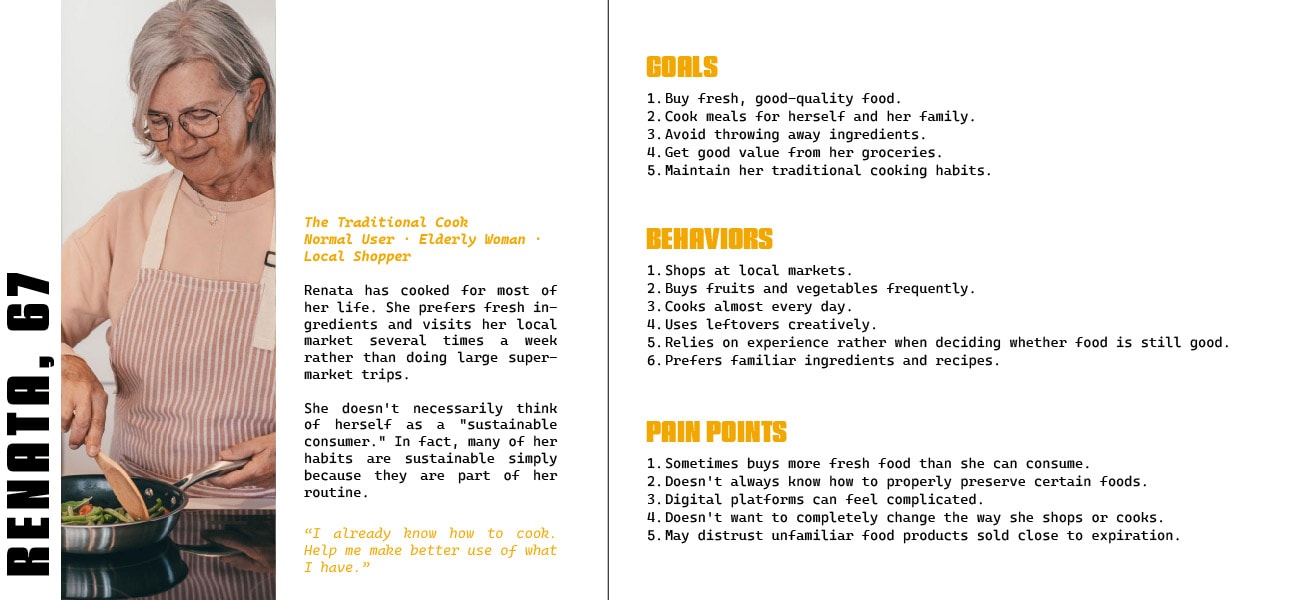
For our interviews, we chose four different groups: everyday consumers, chefs and cooks, restaurant owners, and vegans.
Everyday consumers were the easiest group to reach, as we could interview anyone who cooks, eats out, and buys their own groceries. The other groups were a bit more challenging.
For chefs and cooks, we managed to connect with digital influencers to better understand their experiences in the food industry and how they handle food preparation at home.
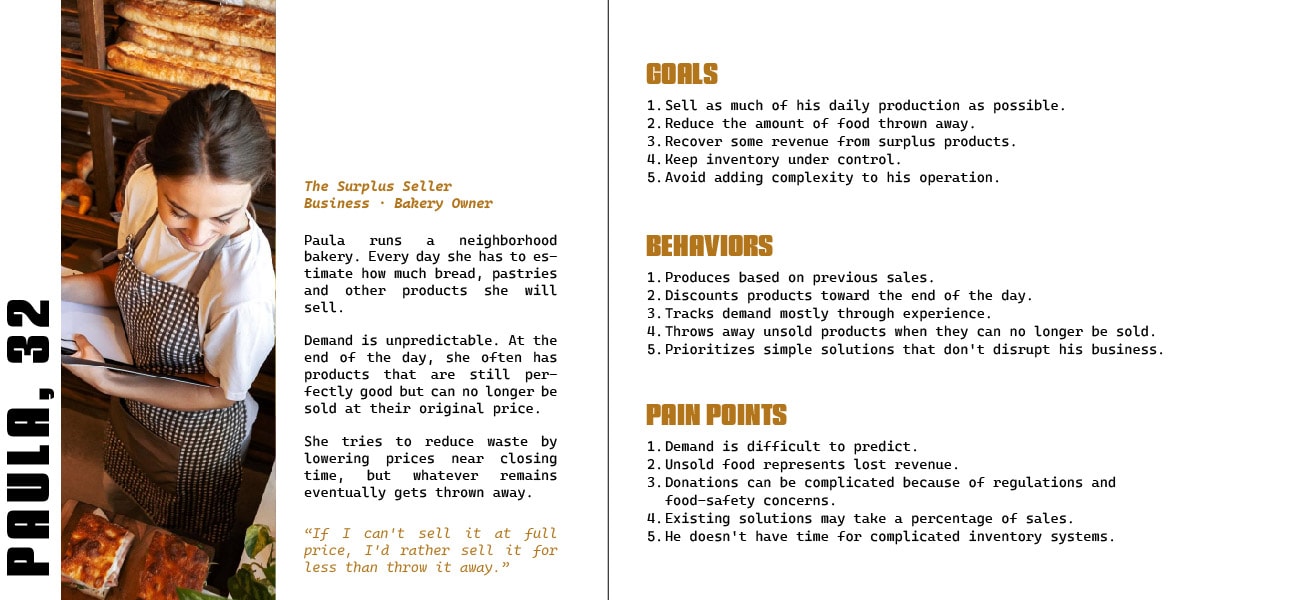
For restaurant owners, we had to visit bakeries and local businesses in person to get in touch with their owners. We also tried to contact a fast-food chain, but unfortunately, we were unsuccessful.
Vegans were the last group we decided to interview, and we regret not doing it sooner. We specifically chose vegans who were actively involved with environmental or social causes. Their lifestyle already involves being more conscious about food waste (any waste in general).
Their insights made it much easier for us to understand the problem from a different perspective and identify better ways to tackle food waste.
We developed a different interview script for each user group. We used our CSD Matrix and the benchmarks we gathered through desk research to develop the questions. Below, you can find the seven scripts we prepared. We did not use every question; instead, we selected the ones that were most relevant at the time of each interview.
just 14%
of businesses have strategies to reduce food waste.
more than 70%
believe a new strategy would be a good idea.
90% consumers
want to reduce their food waste. They just don’t know how.
INTERVIEW INSIGHTS
INTERVIEW INSIGHT #1
Measuring food waste raises awareness and enables action.
INTERVIEW INSIGHT #2
Understanding the target audience influences menu planning.
INTERVIEW INSIGHT #3
Employees are a key tool for preventing food waste.
INTERVIEW INSIGHT #4
Demand predictability enables better control over food purchasing and production.
INTERVIEW INSIGHT #5
Concern about food waste depends on the business model and company culture.
INTERVIEW INSIGHT #6
Team knowledge and training lead to better use of ingredients and reduce waste.
INTERVIEW INSIGHT #7
Food safety regulations can make food donations difficult.
INTERVIEW INSIGHT #8
How food is displayed can influence waste.
INTERVIEW INSIGHT #9
Menu flexibility is important for preventing food waste.
INTERVIEW INSIGHT #10
Working with the right suppliers enables more precise food management.
INTERVIEW INSIGHT #11
Using specialized suppliers for different types of food can help prevent waste.
INTERVIEW INSIGHT #12
Good inventory management helps reduce food waste.
HOW IT WORKS?
The platform offers three core features: food saving, instructions on how to save food, and the reasons behind saving food. Firstly, transparency is paramount. Upon opening the app, users should immediately see how much food has been saved, confirmation that the system is functioning, and assurance that it's the right solution. Secondly, users can browse our daily deals, featuring food items nearing their expiration date that are still perfectly safe and delicious to enjoy. Finally, as an optional feature, users can explore suggested recipes based on their purchases for the day.
ABOUT
Transparency on the amount of food people have already saved.
DEALS
Daily deals on ingredients, prepared food, fruits, and other consumables.
COOKING
Ibi offers a range of recepies, with option to buy the ingredients.
SAVING
Anything the user decides to do in our app will reflect in saving food.

HOME
User Testing Insights
The platform provides information about food waste, user results, progress, and daily news. At first, the experience didn’t feel as intuitive as other food delivery apps. However, through user testing, we identified an important behavior pattern.
When products were displayed directly on the homepage, users would immediately place their orders and ignore the rest of the app. After changing the user flow, we noticed a different behavior: users would browse the news, place their order, and then return to the news section while waiting for their delivery.
This change helped us create a more engaging experience, allowing users to interact with the educational and informative content without getting in the way of the main task.
The waiting time became an opportunity for engagement and education rather than dead time.
PRODUCTS AND PAYMENT
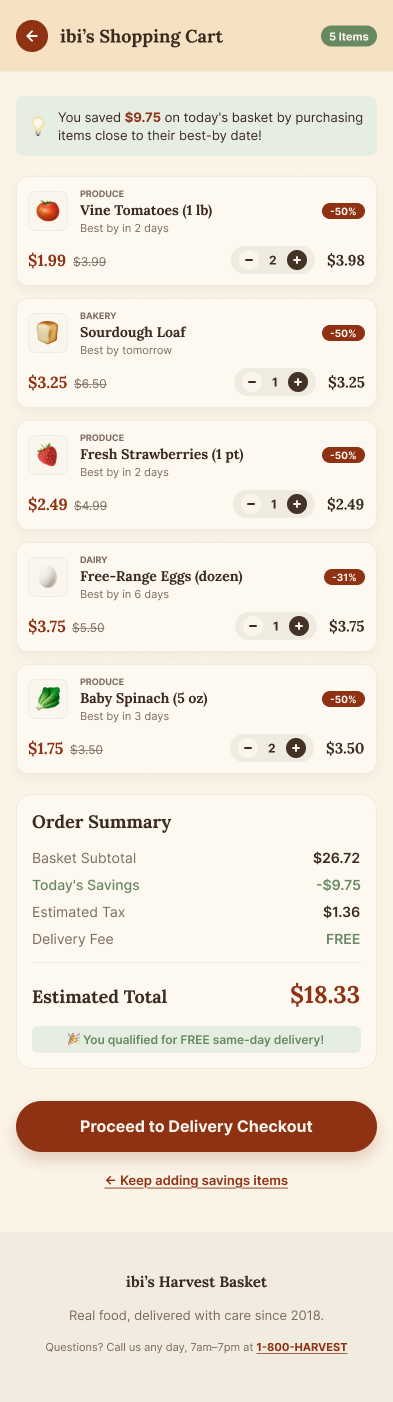
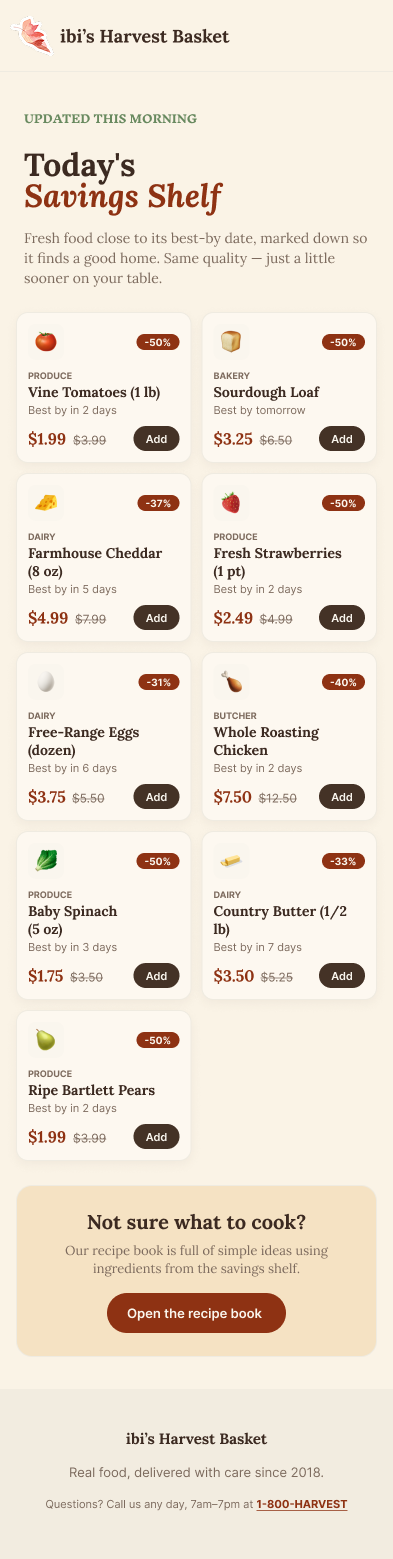
First, we couldn’t use photos of the products. We considered creating illustrations instead, but through testing, we found that icons provided a clearer and more intuitive way to navigate the experience.
One feature we haven’t tested yet is a search bar combined with filters. We intentionally left it out in the first version based on a hypothesis: if users sign up specifically to buy bread, they may not be interested in exploring other products. Our next step would be to test this hypothesis and understand whether search and filtering would actually help users discover more products—or simply add unnecessary complexity.
The delivery flow, on the other hand, was intentionally kept as simple as possible. We considered showing users how much food they were helping to save with each purchase, but we didn’t have a consistent way to accurately measure this impact. We also worried that introducing another number could create confusion rather than value.
DELIVERY AND CUPONS
Turning Waiting Time into Engagement
This was one of my favorite pages to work on.
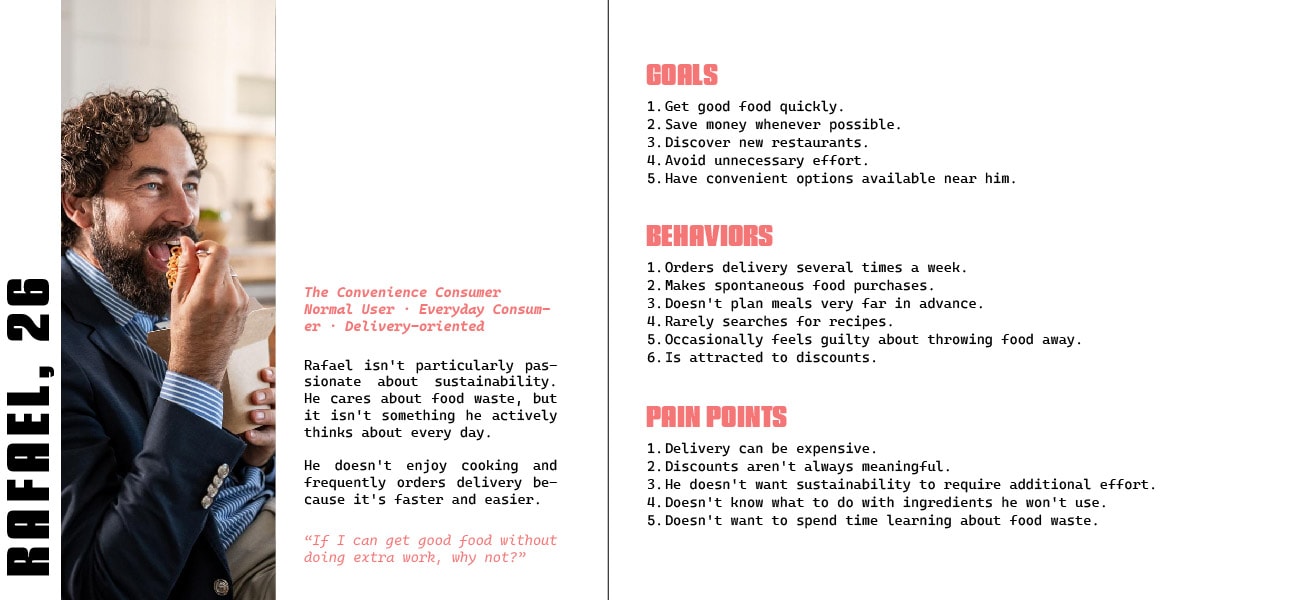
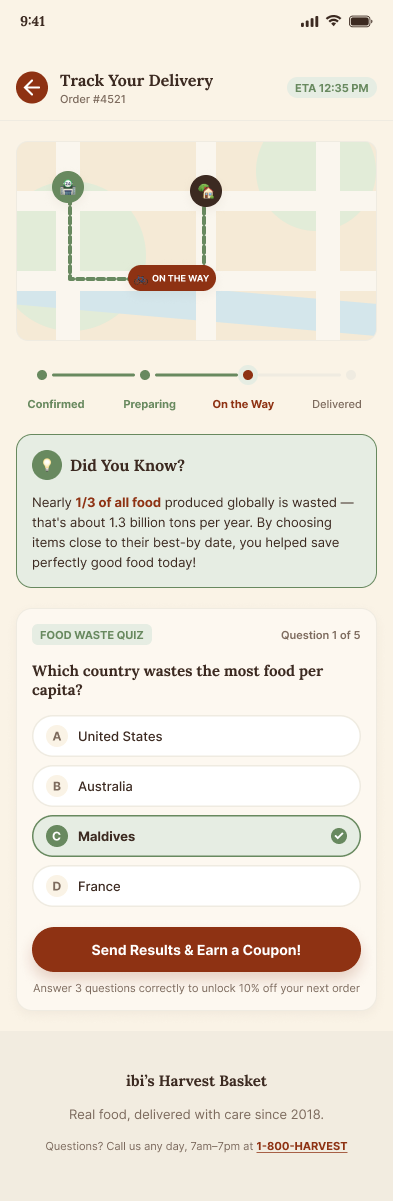
When interviewing our “Rafael” persona (the everyday food delivery user) we noticed an interesting behavior. Users tend to feel anxious while waiting for their food to arrive. They frequently check the delivery status and open the map to follow the driver’s location.
We saw an opportunity to turn this waiting time into something more engaging. We incorporated one of our main pillars: education. Instead of simply showing the delivery status, we used the waiting time to introduce useful information while also offering something customers already enjoy: coupons.
At the top, we introduced a trivia card, something quick and interesting to read while waiting. If the user wants to learn more, they can tap it and be taken directly to the news section.
Below that, we added a simple quiz. Answer at least half of the questions correctly and the user unlocks a coupon.
Coupons aren't new in food delivery apps. Our difference is that we turn the coupon into a small reward for engaging with the content.
LEARNINGS
Benchmarks are underused.
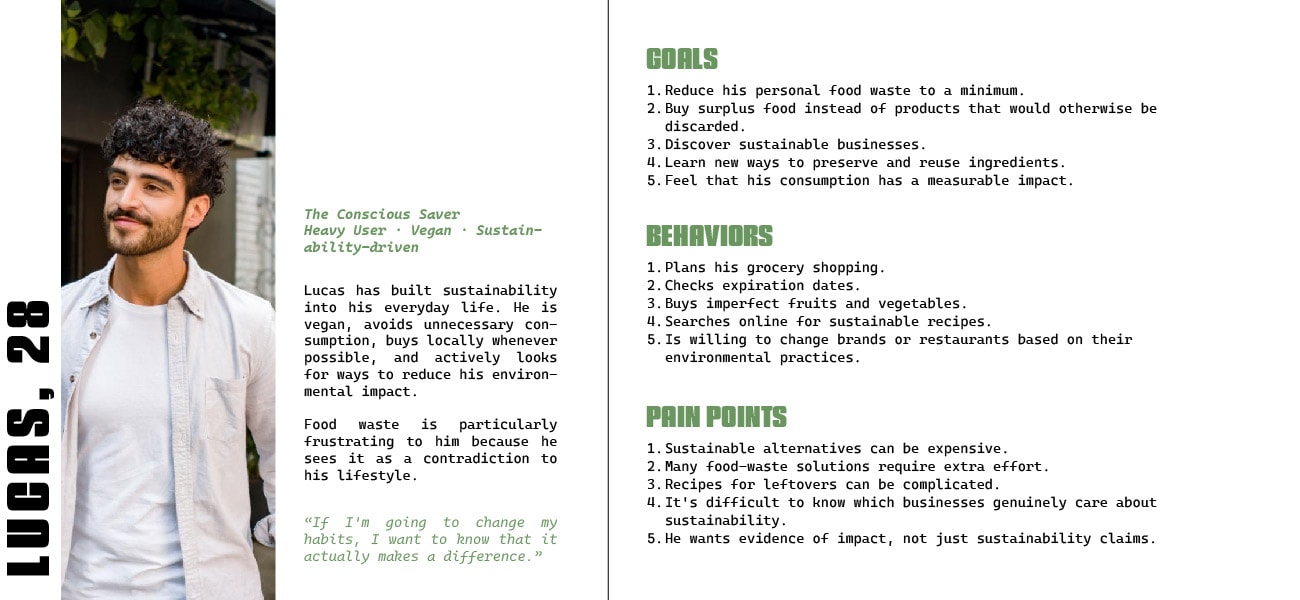
At first, we had a problem identifying who our heavy user would be. Let’s be honest: most of us care about food waste, but not all of us are willing to go the extra step to actively prevent it or do so consistently.
Another challenge was the mindset of, “We, by ourselves, can’t do anything.” And, partially, that’s true. A huge amount of food waste is generated by supermarkets and poorly managed restaurants. But changing the way we consume can push the rest of the food chain to adapt to our needs. That’s where benchmarking came in.
When researching other businesses that were already fighting food waste, we noticed a clear pattern: their target audience was often vegan or strongly environmentally conscious.
The challenge was finding people who fit that same archetype. We had to reach out through friends of friends of friends just to schedule a single interview. But those few interviews we managed to arrange ended up providing some of our most valuable insights.
They helped us understand not only how people think about food waste, but also what motivates them to actually change their behavior.

ODS 12 > ibi
Ibi’s Harvest Basket
No more food waste
Food waste is one of the world's greatest sustainability challenges. Millions of people remain undernourished while approximately one-third of all food produced is lost or wasted. Reducing food waste would decrease the demand for agricultural land and natural resources, lower greenhouse gas emissions—especially from high-impact foods such as beef—and help build a more efficient and environmentally sustainable food system.
Role:
Graphic Designer
Product Designer
Skills:
User Experience
Service Design
Branding
User Interface
ABSTRACT
Ibi is a service to solve a common problem for restaurants. What to do with the food that is left at end of the shift. A business committed to valuing the food that comes from the land by reducing food waste and promoting public awareness about sustainable consumption.A platform that connects restaurants, food retailers, consumers, and delivery partners to reduce food waste by selling surplus food at affordable prices. Every item maintains its quality and is perfectly safe for consumption, delivered through a simple, convenient, and user-friendly experience. A page dedicated to educating the public about food waste through practical tips on making better use of food, sharing sustainability insights, and promoting restaurants and businesses featured on the platform to increase awareness and engagement.
Our mission: To raise awareness, educate on sustainable alternatives and responsible consumption, and promote the platform as a solution for reducing food waste.
HOW WE MADE IT?
This project had a basis of work towards the ONU’s SDG 12: Responsible consumption and production. With the challenge set in mind, we debated tackling it through food consumption. Food waste. We knew the major sources of food waste were in supermarkets, restaurants, and directly at the source with the surplus on farms. Our idea was not to attack the cause, but through the change of our consumption to force the farms and markets to adapt to our demand.
Our first hypothesis was simple: If the user wastes less, consumes what already exists, the supermarket will not throw away unpleasant looking foods, and farms, with the lower demand, would have to produce less.
DOUBLE DIAMOND
DISCOVER
What are the problems? Where they come from?
DEFINE
Which problem should we focus on?
DEVELOP
What are the possible solutions?
DELIVER
Does our solution solves the real problem?
THE USER
STAKEHOLDER MAPPING
HIGH INFLUENCE
Restaurant: Chefs, managers, administrator
MEDIUM INFLUENCE
Clients: On site, delivery
Govern
Staff: Cook, waiter, baker
Suppliers: Food and bevarages
LOW INFLUENCE
Material Supplier
Waste Disposal Business
USER INTERVIEW
For our interviews, we chose four different groups: everyday consumers, chefs and cooks, restaurant owners, and vegans.
Everyday consumers were the easiest group to reach, as we could interview anyone who cooks, eats out, and buys their own groceries. The other groups were a bit more challenging.
For chefs and cooks, we managed to connect with digital influencers to better understand their experiences in the food industry and how they handle food preparation at home.
For restaurant owners, we had to visit bakeries and local businesses in person to get in touch with their owners. We also tried to contact a fast-food chain, but unfortunately, we were unsuccessful.
Vegans were the last group we decided to interview, and we regret not doing it sooner. We specifically chose vegans who were actively involved with environmental or social causes. Their lifestyle already involves being more conscious about food waste (any waste in general).
Their insights made it much easier for us to understand the problem from a different perspective and identify better ways to tackle food waste.
We developed a different interview script for each user group. We used our CSD Matrix and the benchmarks we gathered through desk research to develop the questions. Below, you can find the seven scripts we prepared. We did not use every question; instead, we selected the ones that were most relevant at the time of each interview.
just 14%
of businesses have strategies to reduce food waste.
more than 70%
believe a new strategy would be a good idea.
90% consumers
want to reduce their food waste. They just don’t know how.
INTERVIEW INSIGHTS
INTERVIEW INSIGHT #1
Measuring food waste raises awareness and enables action.
INTERVIEW INSIGHT #2
Understanding the target audience influences menu planning.
INTERVIEW INSIGHT #3
Employees are a key tool for preventing food waste.
INTERVIEW INSIGHT #4
Demand predictability enables better control over food purchasing and production.
INTERVIEW INSIGHT #5
Concern about food waste depends on the business model and company culture.
INTERVIEW INSIGHT #6
Team knowledge and training lead to better use of ingredients and reduce waste.
INTERVIEW INSIGHT #7
Food safety regulations can make food donations difficult.
INTERVIEW INSIGHT #8
How food is displayed can influence waste.
INTERVIEW INSIGHT #9
Menu flexibility is important for preventing food waste.
INTERVIEW INSIGHT #10
Working with the right suppliers enables more precise food management.
INTERVIEW INSIGHT #11
Using specialized suppliers for different types of food can help prevent waste.
INTERVIEW INSIGHT #12
Good inventory management helps reduce food waste.
HOW IT WORKS?
The platform offers three core features: food saving, instructions on how to save food, and the reasons behind saving food. Firstly, transparency is paramount. Upon opening the app, users should immediately see how much food has been saved, confirmation that the system is functioning, and assurance that it's the right solution. Secondly, users can browse our daily deals, featuring food items nearing their expiration date that are still perfectly safe and delicious to enjoy. Finally, as an optional feature, users can explore suggested recipes based on their purchases for the day.
ABOUT
Transparency on the amount of food people have already saved.
DEALS
Daily deals on ingredients, prepared food, fruits, and other consumables.
COOKING
Ibi offers a range of recepies, with option to buy the ingredients.
SAVING
Anything the user decides to do in our app will reflect in saving food.
HOME
User Testing Insights
The platform provides information about food waste, user results, progress, and daily news. At first, the experience didn’t feel as intuitive as other food delivery apps. However, through user testing, we identified an important behavior pattern.
When products were displayed directly on the homepage, users would immediately place their orders and ignore the rest of the app. After changing the user flow, we noticed a different behavior: users would browse the news, place their order, and then return to the news section while waiting for their delivery.
This change helped us create a more engaging experience, allowing users to interact with the educational and informative content without getting in the way of the main task.
The waiting time became an opportunity for engagement and education rather than dead time.
PRODUCTS AND PAYMENT
First, we couldn’t use photos of the products. We considered creating illustrations instead, but through testing, we found that icons provided a clearer and more intuitive way to navigate the experience.
One feature we haven’t tested yet is a search bar combined with filters. We intentionally left it out in the first version based on a hypothesis: if users sign up specifically to buy bread, they may not be interested in exploring other products. Our next step would be to test this hypothesis and understand whether search and filtering would actually help users discover more products—or simply add unnecessary complexity.
The delivery flow, on the other hand, was intentionally kept as simple as possible. We considered showing users how much food they were helping to save with each purchase, but we didn’t have a consistent way to accurately measure this impact. We also worried that introducing another number could create confusion rather than value.
DELIVERY AND CUPONS
Turning Waiting Time into Engagement
This was one of my favorite pages to work on.
When interviewing our “Rafael” persona (the everyday food delivery user) we noticed an interesting behavior. Users tend to feel anxious while waiting for their food to arrive. They frequently check the delivery status and open the map to follow the driver’s location.
We saw an opportunity to turn this waiting time into something more engaging. We incorporated one of our main pillars: education. Instead of simply showing the delivery status, we used the waiting time to introduce useful information while also offering something customers already enjoy: coupons.
At the top, we introduced a trivia card, something quick and interesting to read while waiting. If the user wants to learn more, they can tap it and be taken directly to the news section.
Below that, we added a simple quiz. Answer at least half of the questions correctly and the user unlocks a coupon.
Coupons aren't new in food delivery apps. Our difference is that we turn the coupon into a small reward for engaging with the content.
HOME SCREEN
About Inovalab, how it works.
Benefits for students and business.
Quicky preview of featured cases.
DEALS
Dashboard for students:
Currently enrolled case. Progress.
Study group forum. User tasks.
Dashboard for business:
Open cases. Update new information.
Follow-up progress.
COOKING
Backstage follow up. For teachers and
Inovalab’s staff. Case catalog and
individual student feedbacks.
DESIGN SYSTEM
Please, feel free to navigate the design system below (Only a preview).
DOCUMENTATION
DOCUMENTATION
Design Principles
ABOUT
Transparency on the amount of food people have already saved.
DEALS
Daily deals on ingredients, prepared food, fruits, and other consumables.
COOKING
Ibi offers a range of recepies, with option to buy the ingredients.
SAVING
Anything the user decides to do in our app will reflect in saving food.
LEARNINGS
Benchmarks are underused.
At first, we had a problem identifying who our heavy user would be. Let’s be honest: most of us care about food waste, but not all of us are willing to go the extra step to actively prevent it or do so consistently.
Another challenge was the mindset of, “We, by ourselves, can’t do anything.” And, partially, that’s true. A huge amount of food waste is generated by supermarkets and poorly managed restaurants. But changing the way we consume can push the rest of the food chain to adapt to our needs. That’s where benchmarking came in.
When researching other businesses that were already fighting food waste, we noticed a clear pattern: their target audience was often vegan or strongly environmentally conscious.
The challenge was finding people who fit that same archetype. We had to reach out through friends of friends of friends just to schedule a single interview. But those few interviews we managed to arrange ended up providing some of our most valuable insights.
They helped us understand not only how people think about food waste, but also what motivates them to actually change their behavior.