UNIFACISA > INOVALAB
Inovalab: Developing Student’s Work Experience
This project presents the solution developed for Unifacisa. The challenge was to reposition Inovalab by incorporating a career development pillar into its strategy. Following a diagnostic assessment, it became clear that the Unifacisa Consulting Program had significant potential to help students develop professional skills and facilitate their transition into the job market.
Role:
Graphic Designer
Product Designer
Skills:
User Experience
Service Design
Branding
User Interface
ABSTRACT
Students frequently study subjects that aren’t directly related to their future careers. Today, even entry—evel positions demand prior work experience, which can be gained through internships or extracurricular projects. Inovalab’s goal is to equip students for their professional journeys.
The process is straightforward: a partner company presents a real world case, and Inovalab oversees the project. Students then tackle the project with guidance from their teachers.
Inovalab is an extracurricular program offered by Unifacisa to its students. Before we took on this challenge, Inovalab focused on interdisciplinary courses and supporting students who wanted to develop their own businesses.
The challenge we faced was to redefine Inovalab’s direction and address the difficulties students encounter when preparing for their future professional lives.
HOW WE MADE IT?
Initially, we encountered a common challenge: "How can students gain practical work experience while managing their college commitments?" Internships, while valuable, weren't a viable sole solution for two key reasons. Firstly, the limited availability of internships meant not every student could secure one. Secondly, personal circumstances, such as being the primary breadwinner for a family or caring for a loved one, often made internships impractical, especially given their typically modest compensation. With this issue at the forefront, we focused on developing a solution that would allow students to acquire work experience within the college environment and on a schedule that accommodated their already demanding routines.
DOUBLE DIAMOND
DISCOVER
What are the problems? Where they come from?
DEFINE
Which problem should we focus on?
DEVELOP
What are the possible solutions?
DELIVER
Does our solution solves the real problem?
THE USER
USER INTERVIEW
For our interviews, we chose four different groups: students, teachers, alumni, and business owners. Students were not difficult to interview, as we had plenty of students who were eager to participate. Teachers, however, presented a challenge, as their answers might not have been entirely honest. They could have been concerned that sharing their struggles might interfere with their employment contracts. We expected business owners to be more difficult to interview, but we had no problems finding participants because Unifacisa already had established partnerships.
We developed a different interview script for each user group. We used our CSD Matrix and the benchmarks we gathered through desk research to develop the questions. Below, you can find the seven scripts we prepared. We did not use every question; instead, we selected the ones that were most relevant at the time of each interview.
STUDENT NEVER ENGAGED IN UNIFACISA ACTIVITIES
STUDENT TOOK PART IN UNIFACISA ACTIVITIES
TEACHERS INVOLVED IN UNIFACISA ACTIVITIES
TEACHERS NOT INVOLVED IN UNIFACISA ACTIVITIES
ALUMNI
INOVALAB STAFF
BUSINESS OWNERS
COORDINATORS

1
STUDENT THAT NEVER ENGAGED IN UNIFACISA ACTIVITIES
- Why did you choose Unifacisa?
- What course are you currently studying, and what semester are you in?
- What does a “career” mean to you? How do you plan to develop yours?
- What do you talk to your friends about regarding careers? What are your main concerns?
- What would you like your job and workplace to be like?
- Have you ever participated in a recruitment process? What was the experience like? What difficulties did you face?
- What do you understand by entrepreneurship? Have you ever considered starting your own business?
- What do you understand by hard skills and soft skills? Have you ever taken any training or courses in these areas?
- How do you think the university could contribute more to your career development?
- On a scale of 0 to 10, how important is an innovation environment to a student’s career?
- What do you think is important to learn in an environment focused on innovation and career development?
- Have you heard of or are you familiar with Inovalab? If so, could you explain what they do?
- How did you first hear about Inovalab? Do you receive updates about upcoming Inovalab activities?
- Do you know or follow any of Inovalab’s social media accounts?
- Have you ever considered participating in Inovalab?
- What is your perception of Inovalab, and what role do you think it plays in the university environment?
- If Inovalab were a person, how would you describe them?
- Are you familiar with any other innovation labs? What is your perception of them?
INTERVIEW INSIGHTS
INTERVIEW INSIGHT #1
Students...
It feels like being thrown into the job market without any work experience.
INTERVIEW INSIGHT #2
Students...
They feel they lack the hard skills that can only be developed through hands-on work experience.
INTERVIEW INSIGHT #3
Students...
Balancing studying and work makes it difficult to find time to participate in Inovalab.
INTERVIEW INSIGHT #4
Alumni...
They feel that the professional world is very different from what they expected as students.
INTERVIEW INSIGHT #5
Students...
They got internships through opportunities, while others never had the chance to experience them.
INTERVIEW INSIGHT #6
Students...
There’s a lack of mentorship to prepare the students towards real work life situations.
INTERVIEW INSIGHT #7
Teachers and students...
They feel that Unifacisa’s activities are too generic and fail to engage or capture students’ interest.
INTERVIEW INSIGHT #8
Coordinators and Teachers .....
They feel they have little input into the decisions made between Unifacisa and business owners.
INTERVIEW INSIGHT #9
Business Owners...
They believe Inovalab could be a great opportunity to recruit new trainees.
INTERVIEW INSIGHT #10
Students and
Business Owners...
They feel that new employees lack soft skills.
INTERVIEW INSIGHT #11
Business Owners...
They want real-world results, not simulations.
INTERVIEW INSIGHT #12
Business Owners...
It’s hard for them to make time for non-work-related activities.
USER JOURNEY
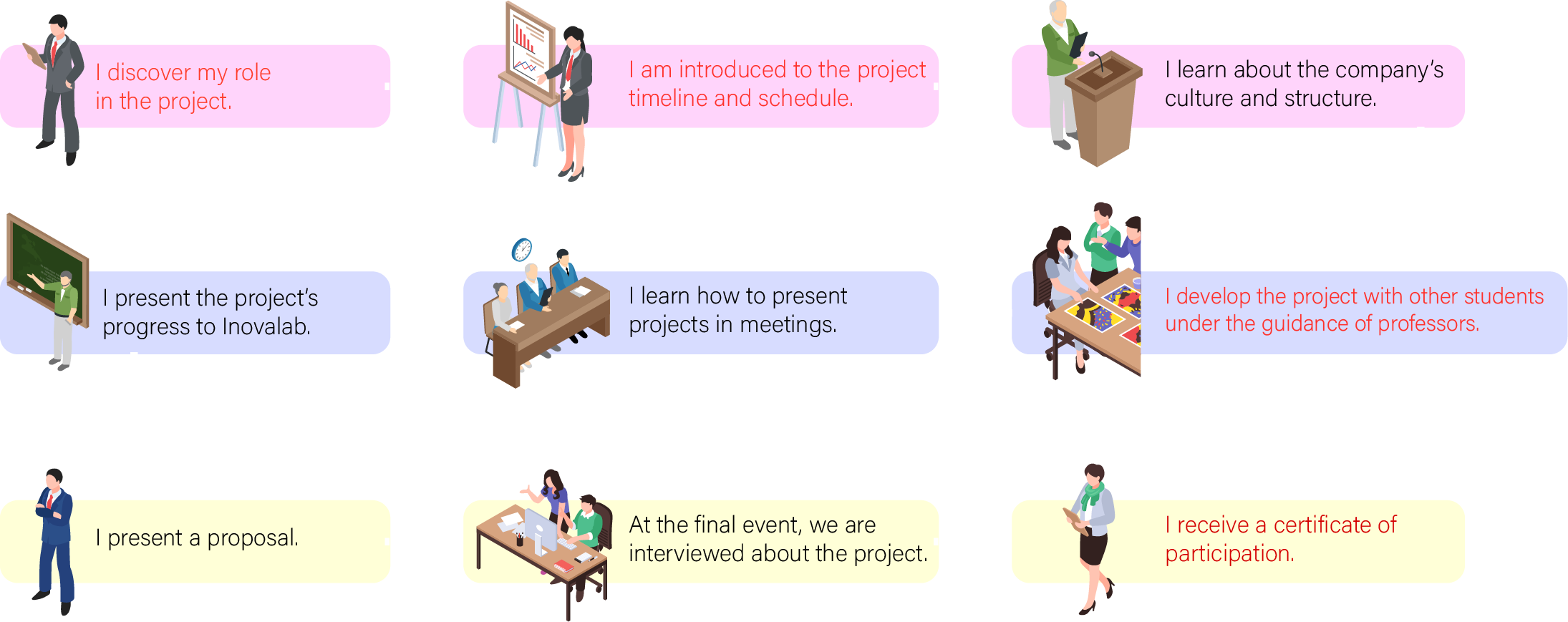
Based on our understanding of students’ daily lives, we decided to map their journey. Our goal was to identify pain points and moments of friction that could validate or challenge the insights we had previously uncovered. The user journey we defined 3 phases: before, during, and after.
BEFORE - DISCOVERY AND ENROLL PHASE
STEP 1: Discoverying Inovalab
I find out about Inovalab through Social Media.
A teacher told me about Inovalab.
I read on the school board about Inovalab.
STEP 2: Enroll to Inovalab
- I apply through the public call for applications.
- I participate in the selection process through a form.
- I am notified of my acceptance via email.
DURING - INOVALAB ACTIVITIES

AFTER - RESIDUAL
STEP 1:
I stay in touch with people I met through Inovalab.
STEP 2
I am informed about new Inovalab activities.
STEP 3
I am not interested in other activities.
I am unable to participate due to scheduling conflicts.
WHAT WE LEARNED
We identified important topics that would become our focal points for this project. These topics were highlighted in red in the user journey and compared with the interviews we conducted previously.
“I find out about Inovalab through Social Media [...]”: There’s a lack of an oficial channel for Inovalab’s annoucements.
“I apply through the public call for applications.”: Same as before. A lack of an official channel.
“I discover my role in the project”: Student can’t understand what skill they will develop.
“I am introduced to the project timeline and schedule”: The student can’t understand his role during the project.
“I develop the project with other students [...]”: If there’s a lack of students from other courses, there will be missing a few roles.
“I receive a certificate of participation.”: For some students there’s a understanding the project ended there. Without any news about the project they worked on.
“I am unable to participate due to schedulling conflicts”: For some students they can’t be present every day at Inovalab due to their work or study. Lack of flexibility.
Our project is heavily focused on the student, since to our understanding the teachers and business needs will be shaped after the students problems. For the next step of our project, we will conduct a workshop to research the teachers and business intervantion.
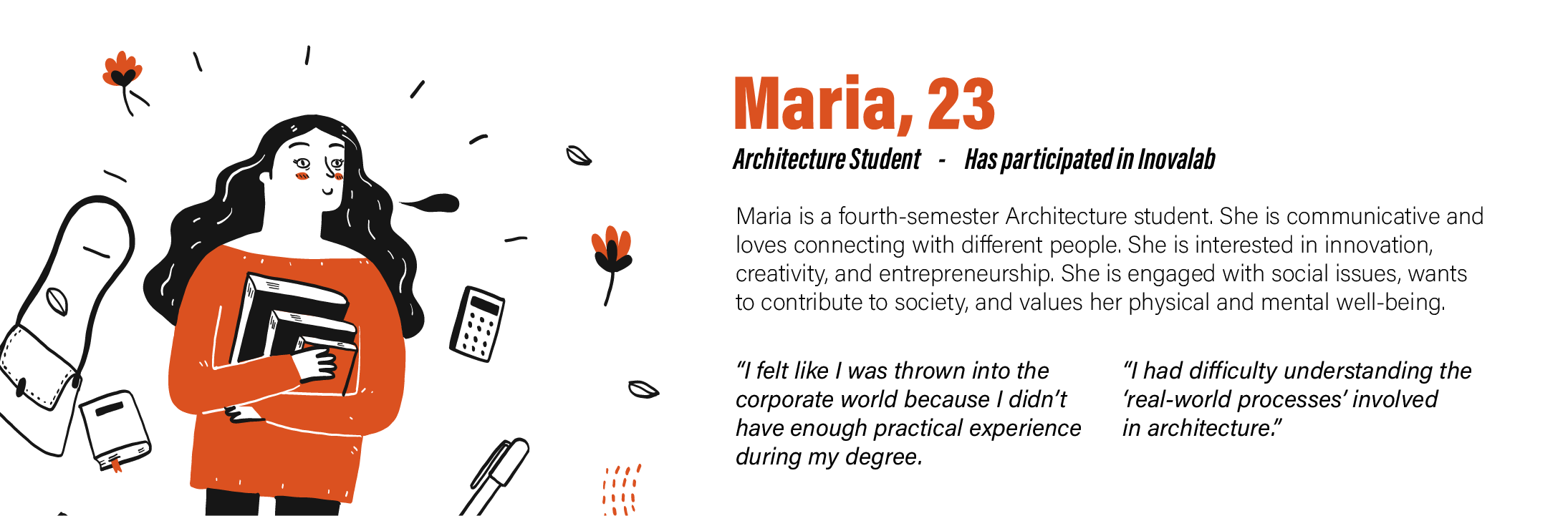
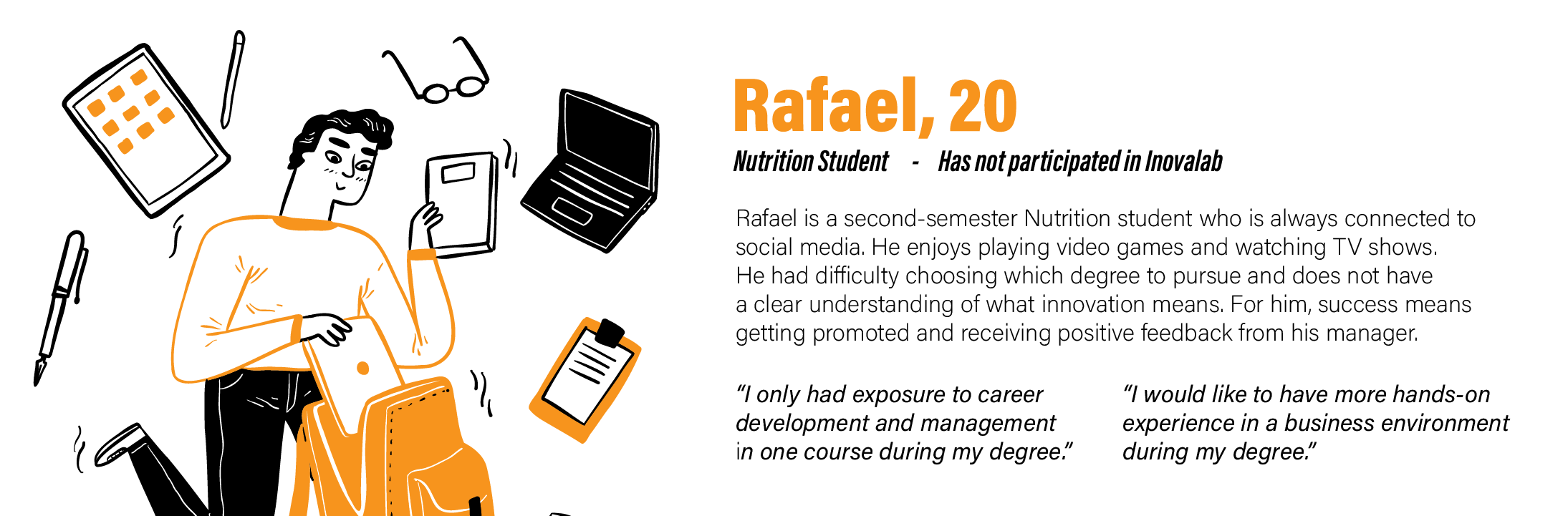
PERSONA
WORKSHOP
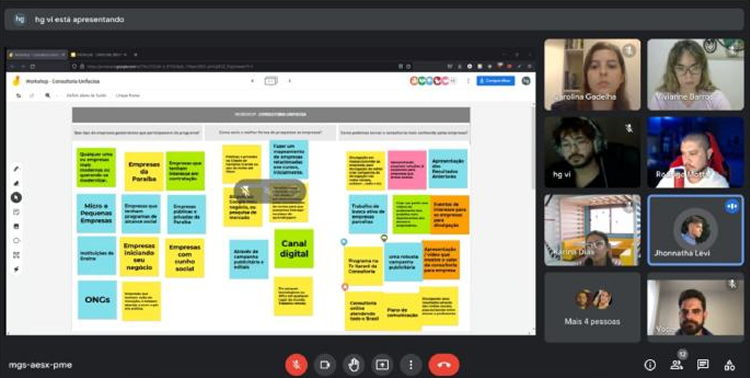
To better define and shape our solution, we chose to work together with our future users. Together, we explored and developed possible solutions to address the problems and focal points identified earlier.
The workshop brought together staff members, faculty, students, business owners, and program coordinators.The insights gathered were synthesized into an initial solution concept, which served as the foundation for a co-creation session with the Inovalab coordinators to further refine and validate the proposed direction.

17 Questions
were brought to the workshop. These questions were related to the key attention points we identified through our interviews and user journey.
250+ Total
were gathered and transformed into insights.
11 Insights Ideas
were identified as the most important strengths, weaknesses, opportunities, and threats.
The 11 (Most important) Insights
INSIGHT #1
There’s a lack of an organized system.
INSIGHT #2
There’s no prospecting channel for business owners.
INSIGHT #3
There’s no methodology or standard presentation.
INSIGHT #4
Lack of clear boundaries business owners.
INSIGHT #5
There’s no defined schedule with the business.
INSIGHT #6
Students find out about Inovalab through their teachers.
INSIGHT #7
There’s no official channel for students to follow Inovalab.
INSIGHT #8
Students are confused about their roles and what skills they will develop.
INSIGHT #9
There’s a lack of consideration for students’ schedules.
INSIGHT #10
Students only interact with each other while at Inovalab. Outside there’s no team work.
INSIGHT #11
There’s a lack of feedback once the project is completed.
THE SOLUTION
THE NEW USER JOURNEY
process
Project Format
For the first version, there will be four projects, with one project per company. Alternatively, a single company may offer up to four projects.
Project Duration
There will be two application calls per year, with each project running for four months.
Project Phases
The project phases will be structured according to the stages of the Design Thinking methodology.
Work Methodology
The idea is to use Design Thinking and the Double Diamond framework. However, recognizing the specific needs of each project, tutors will have the flexibility to use complementary project management tools and agile methodologies when appropriate.
Skills Developed
Through these projects, students will have the opportunity to develop skills in Leadership, Collaboration, Systems Thinking, Creativity and Innovation, and Problem-Solving.
Learning Path
The learning path will consist of the different project stages, combined with courses, lectures, and workshops made available to students.
Unifacisa boasts numerous business partners like Santander, Accenture, Hospital Help, and Babson College. These collaborations provide benefits such as tax exemptions, support for research and development, discounts on corporate training, and, crucially, direct access to emerging talent.
BUSINESS
Propose a real technical business challenges through capstone projects
INOVALAB
Intermediary and main assistance for students and teachers alike.
STUDENT
Protagonists and focus of the service. Work towards the project.
DELIVERY
Last step. Students will introduce their projects directly to the business.
HOME SCREEN
About Inovalab, how it works.
Benefits for students and business.
Quicky preview of featured cases.
DASHBOARD
Dashboard for students:
Currently enrolled case. Progress.
Study group forum. User tasks.
Dashboard for business:
Open cases. Update new information.
Follow-up progress.
ADMIN CONTROL
Backstage follow up. For teachers and
Inovalab’s staff. Case catalog and
individual student feedbacks.
OUTCOME (Over 3 years)
18 CASES
Delivered studies over the course of six semesters.
12+ BUSINESS
Partners in the finance and administration sectors.
36% STUDENTS
36% recent graduate students ready to work.
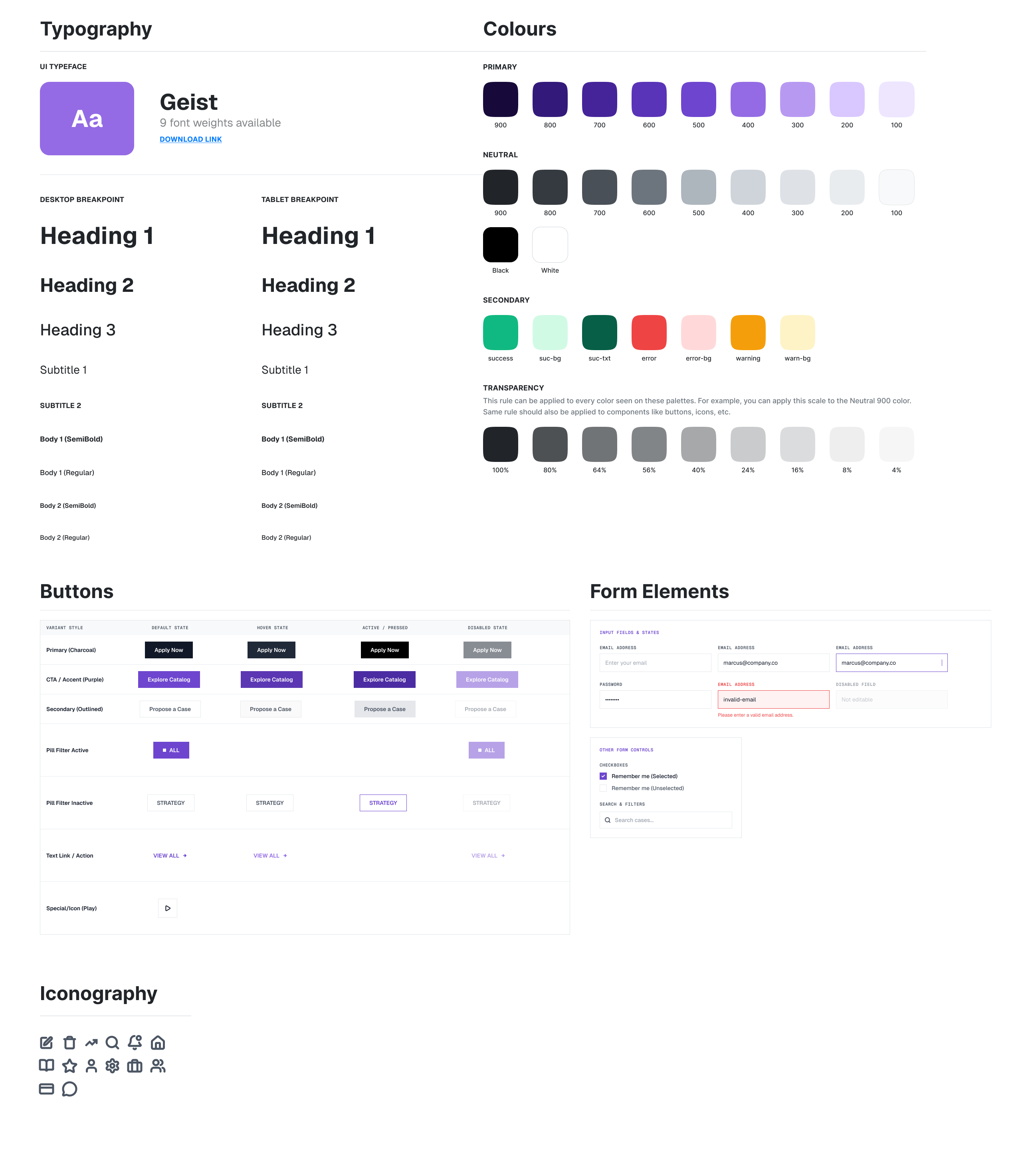
BRANDING
Inovalab as new product was in need of a new identity and a design system. Working in a new branding and a design system at the same time was a opportunity to develop from the start. For Inovalab I had to focus in a few key points:
AGE RANGE
Most Inovalab’s students range between 20 and 30 years old. While the business representatives between 30 and 40.
WORK EXPERIENCE
To achieve a truly work experience, the brand had to resemble currently softwares, like Miro, Jira, and ClickUp.
UNIFACISA
The client does not want Inovalab to look like Unifacisa, but for marketing reasons, we choose a in between.
TECHNOLOGY
Inovalab’s students have a desire to work in the financial, fintech, start-ups and technology sectors.
NEXT STEP
BUSINESS FOLLOW-UP
Follow up with business owners after the project.
We want to understand their overall experience and identify opportunities for improvement. How did they feel about working with students? Did the collaboration meet their expectations?
We also want to know whether any students were recruited after the project. If so, did the business owner notice a difference in their performance or preparation? Did the student seem better prepared for the demands of the workplace because of their INOVALAB experience?
PROJECT SUCCESS
Did the project reached success? Did it work? if so, was there any possibility to continue with the work?
Student Engagement
Interview students who have completed INOVALAB.
It’s important for us to understand their experience: whether the program was stressful, what skills they developed, and whether it increased their motivation and confidence toward their future careers.
We need to understand their challenges and use these insights to continuously adapt and improve our solution. If necessary, we can update the experience based on their feedback.

UNIFACISA > INOVALAB
Inovalab: Developing Student’s Work Experience
This project presents the solution developed for Unifacisa. The challenge was to reposition Inovalab by incorporating a career development pillar into its strategy. Following a diagnostic assessment, it became clear that the Unifacisa Consulting Program had significant potential to help students develop professional skills and facilitate their transition into the job market.
Role:
Graphic Designer
Product Designer
Skills:
User Experience
Service Design
Branding
User Interface
ABSTRACT
Students frequently study subjects that aren’t directly related to their future careers. Today, even entry—evel positions demand prior work experience, which can be gained through internships or extracurricular projects. Inovalab’s goal is to equip students for their professional journeys.
The process is straightforward: a partner company presents a real world case, and Inovalab oversees the project. Students then tackle the project with guidance from their teachers.
Inovalab is an extracurricular program offered by Unifacisa to its students. Before we took on this challenge, Inovalab focused on interdisciplinary courses and supporting students who wanted to develop their own businesses.
The challenge we faced was to redefine Inovalab’s direction and address the difficulties students encounter when preparing for their future professional lives.
HOW WE MADE IT?
Initially, we encountered a common challenge: "How can students gain practical work experience while managing their college commitments?" Internships, while valuable, weren't a viable sole solution for two key reasons. Firstly, the limited availability of internships meant not every student could secure one. Secondly, personal circumstances, such as being the primary breadwinner for a family or caring for a loved one, often made internships impractical, especially given their typically modest compensation. With this issue at the forefront, we focused on developing a solution that would allow students to acquire work experience within the college environment and on a schedule that accommodated their already demanding routines.
DOUBLE DIAMOND
DISCOVER
What are the problems? Where they come from?
DEFINE
Which problem should we focus on?
DEVELOP
What are the possible solutions?
DELIVER
Does our solution solves the real problem?
THE USER
USER INTERVIEW
For our interviews, we chose four different groups: students, teachers, alumni, and business owners. Students were not difficult to interview, as we had plenty of students who were eager to participate. Teachers, however, presented a challenge, as their answers might not have been entirely honest. They could have been concerned that sharing their struggles might interfere with their employment contracts. We expected business owners to be more difficult to interview, but we had no problems finding participants because Unifacisa already had established partnerships.
We developed a different interview script for each user group. We used our CSD Matrix and the benchmarks we gathered through desk research to develop the questions. Below, you can find the seven scripts we prepared. We did not use every question; instead, we selected the ones that were most relevant at the time of each interview.
STUDENT NEVER ENGAGED IN UNIFACISA ACTIVITIES
STUDENT TOOK PART IN UNIFACISA ACTIVITIES
TEACHERS INVOLVED IN UNIFACISA ACTIVITIES
TEACHERS NOT INVOLVED IN UNIFACISA ACTIVITIES
ALUMNI
INOVALAB STAFF
BUSINESS OWNERS
COORDINATORS
1
STUDENT THAT NEVER ENGAGED IN UNIFACISA ACTIVITIES
- Why did you choose Unifacisa?
- What course are you currently studying, and what semester are you in?
- What does a “career” mean to you? How do you plan to develop yours?
- What do you talk to your friends about regarding careers? What are your main concerns?
- What would you like your job and workplace to be like?
- Have you ever participated in a recruitment process? What was the experience like? What difficulties did you face?
- What do you understand by entrepreneurship? Have you ever considered starting your own business?
- What do you understand by hard skills and soft skills? Have you ever taken any training or courses in these areas?
- How do you think the university could contribute more to your career development?
- On a scale of 0 to 10, how important is an innovation environment to a student’s career?
- What do you think is important to learn in an environment focused on innovation and career development?
- Have you heard of or are you familiar with Inovalab? If so, could you explain what they do?
- How did you first hear about Inovalab? Do you receive updates about upcoming Inovalab activities?
- Do you know or follow any of Inovalab’s social media accounts?
- Have you ever considered participating in Inovalab?
- What is your perception of Inovalab, and what role do you think it plays in the university environment?
- If Inovalab were a person, how would you describe them?
- Are you familiar with any other innovation labs? What is your perception of them?
INTERVIEW INSIGHTS
INTERVIEW INSIGHT #1
Students...
It feels like being thrown into the job market without any work experience.
INTERVIEW INSIGHT #2
Students...
They feel they lack the hard skills that can only be developed through hands-on work experience.
INTERVIEW INSIGHT #3
Students...
Balancing studying and work makes it difficult to find time to participate in Inovalab.
INTERVIEW INSIGHT #4
Alumni...
They feel that the professional world is very different from what they expected as students.
INTERVIEW INSIGHT #5
Students...
They got internships through opportunities, while others never had the chance to experience them.
INTERVIEW INSIGHT #6
Students...
There’s a lack of mentorship to prepare the students towards real work life situations.
INTERVIEW INSIGHT #7
Teachers and students...
They feel that Unifacisa’s activities are too generic and fail to engage or capture students’ interest.
INTERVIEW INSIGHT #8
Coordinators and Teachers .....
They feel they have little input into the decisions made between Unifacisa and business owners.
INTERVIEW INSIGHT #9
Business Owners...
They believe Inovalab could be a great opportunity to recruit new trainees.
INTERVIEW INSIGHT #10
Students and
Business Owners...
They feel that new employees lack soft skills.
INTERVIEW INSIGHT #11
Business Owners...
They want real-world results, not simulations.
INTERVIEW INSIGHT #12
Business Owners...
It’s hard for them to make time for non-work-related activities.
USER JOURNEY
Based on our understanding of students’ daily lives, we decided to map their journey. Our goal was to identify pain points and moments of friction that could validate or challenge the insights we had previously uncovered. The user journey we defined 3 phases: before, during, and after.
BEFORE - DISCOVERY AND ENROLL PHASE
STEP 1: Discoverying Inovalab
I find out about Inovalab through Social Media.
A teacher told me about Inovalab.
I read on the school board about Inovalab.
STEP 2: Enroll to Inovalab
- I apply through the public call for applications.
- I participate in the selection process through a form.
- I am notified of my acceptance via email.
DURING - INOVALAB ACTIVITIES
AFTER - RESIDUAL
STEP 1:
I stay in touch with people I met through Inovalab.
STEP 2
I am informed about new Inovalab activities.
STEP 3
I am not interested in other activities.
I am unable to participate due to scheduling conflicts.
WHAT WE LEARNED
We identified important topics that would become our focal points for this project. These topics were highlighted in red in the user journey and compared with the interviews we conducted previously.
“I find out about Inovalab through Social Media [...]”: There’s a lack of an oficial channel for Inovalab’s annoucements.
“I apply through the public call for applications.”: Same as before. A lack of an official channel.
“I discover my role in the project”: Student can’t understand what skill they will develop.
“I am introduced to the project timeline and schedule”: The student can’t understand his role during the project.
“I develop the project with other students [...]”: If there’s a lack of students from other courses, there will be missing a few roles.
“I receive a certificate of participation.”: For some students there’s a understanding the project ended there. Without any news about the project they worked on.
“I am unable to participate due to schedulling conflicts”: For some students they can’t be present every day at Inovalab due to their work or study. Lack of flexibility.
Our project is heavily focused on the student, since to our understanding the teachers and business needs will be shaped after the students problems. For the next step of our project, we will conduct a workshop to research the teachers and business intervantion.
PERSONA
WORKSHOP
To better define and shape our solution, we chose to work together with our future users. Together, we explored and developed possible solutions to address the problems and focal points identified earlier.
The workshop brought together staff members, faculty, students, business owners, and program coordinators.The insights gathered were synthesized into an initial solution concept, which served as the foundation for a co-creation session with the Inovalab coordinators to further refine and validate the proposed direction.
17 Questions
were brought to the workshop. These questions were related to the key attention points we identified through our interviews and user journey.
250+ Total
were gathered and transformed into insights.
11 Insights Ideas
were identified as the most important strengths, weaknesses, opportunities, and threats.
The 11 (Most important) Insights
INSIGHT #1
There’s a lack of an organized system.
INSIGHT #2
There’s no prospecting channel for business owners.
INSIGHT #3
There’s no methodology or standard presentation.
INSIGHT #4
Lack of clear boundaries business owners.
INSIGHT #5
There’s no defined schedule with the business.
INSIGHT #6
Students find out about Inovalab through their teachers.
INSIGHT #7
There’s no official channel for students to follow Inovalab.
INSIGHT #8
Students are confused about their roles and what skills they will develop.
INSIGHT #9
There’s a lack of consideration for students’ schedules.
INSIGHT #10
Students only interact with each other while at Inovalab. Outside there’s no team work.
INSIGHT #11
There’s a lack of feedback once the project is completed.
THE SOLUTION
THE NEW USER JOURNEY
process
Project Format
For the first version, there will be four projects, with one project per company. Alternatively, a single company may offer up to four projects.
Project Duration
There will be two application calls per year, with each project running for four months.
Project Phases
The project phases will be structured according to the stages of the Design Thinking methodology.
Work Methodology
The idea is to use Design Thinking and the Double Diamond framework. However, recognizing the specific needs of each project, tutors will have the flexibility to use complementary project management tools and agile methodologies when appropriate.
Skills Developed
Through these projects, students will have the opportunity to develop skills in Leadership, Collaboration, Systems Thinking, Creativity and Innovation, and Problem-Solving.
Learning Path
The learning path will consist of the different project stages, combined with courses, lectures, and workshops made available to students.
Unifacisa boasts numerous business partners like Santander, Accenture, Hospital Help, and Babson College. These collaborations provide benefits such as tax exemptions, support for research and development, discounts on corporate training, and, crucially, direct access to emerging talent.
BUSINESS
Propose a real technical business challenges through capstone projects
INOVALAB
Intermediary and main assistance for students and teachers alike.
STUDENT
Protagonists and focus of the service. Work towards the project.
DELIVERY
Last step. Students will introduce their projects directly to the business.
HOME
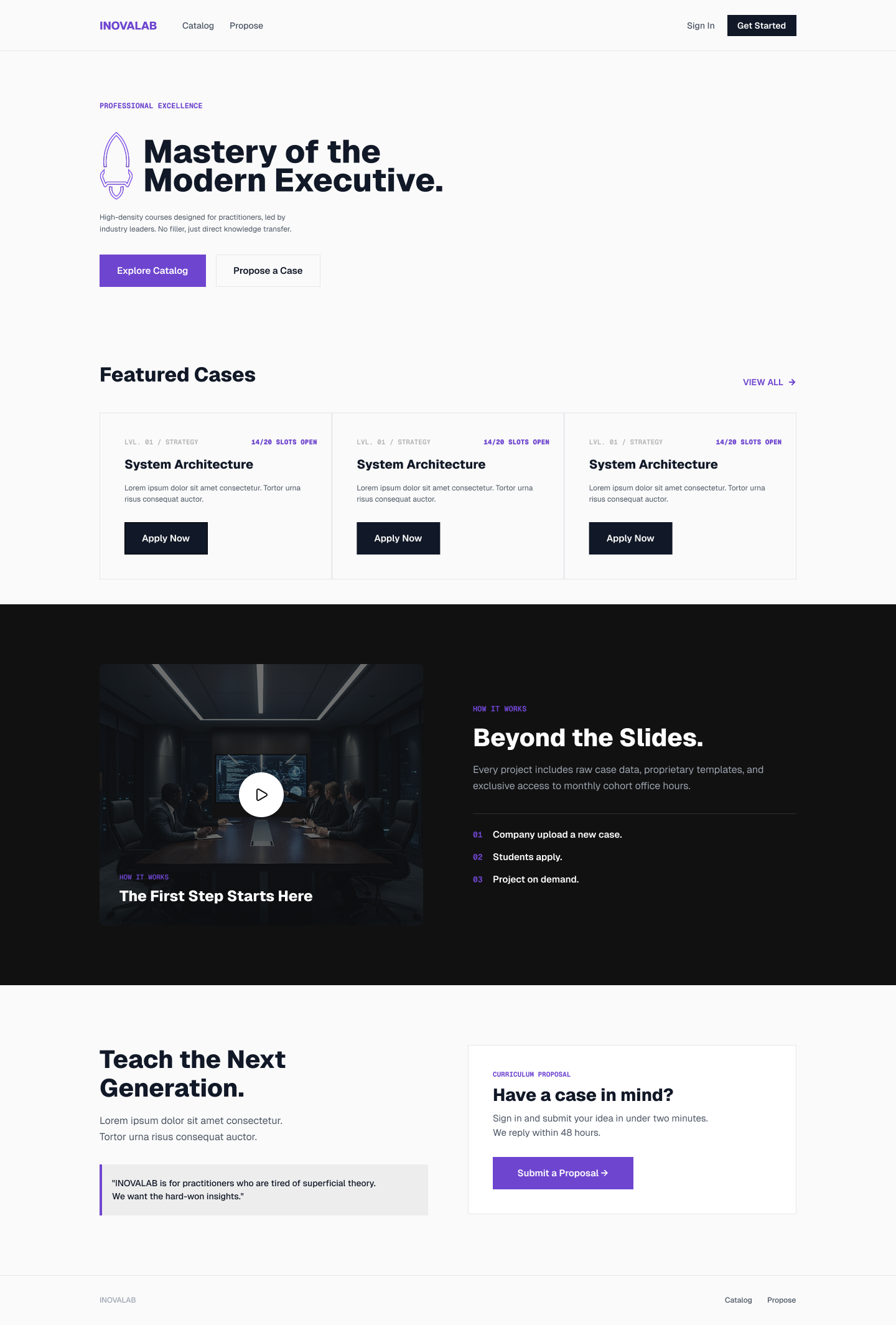
HOME SCREEN
About Inovalab, how it works.
Quicky preview of featured cases.
The goal of this page is to create a central hub for all Inovalab information and updates. It allows users to connect with others, explore new case studies, and, as a company, get in touch with Inovalab to propose new challenges for students to work on.
WHAT PROBLEM INSIGHT IT IS SOLVING:
#2: There’s no prospecting channel for business owners.
#6: Students find out about Inovalab through their teachers.
#7: There’s no official channel for students to follow Inovalab.
KPI AND SUCCESS CRITERIA
Number of clicks on the video;
Featured Cases applied;
Catalog explored.
HOME SCREEN
About Inovalab, how it works.
Benefits for students and business.
Quicky preview of featured cases.
DASHBOARD
Dashboard for students:
Currently enrolled case. Progress.
Study group forum. User tasks.
Dashboard for business:
Open cases. Update new information.
Follow-up progress.
ADMIN CONTROL
Backstage follow up. For teachers and
Inovalab’s staff. Case catalog and
individual student feedbacks.
OUTCOME (Over 3 years)
18 CASES
Delivered studies over the course of six semesters.
12+ BUSINESS
Partners in the finance and administration sectors.
36% STUDENTS
36% recent graduate students ready to work.
BRANDING
Inovalab as new product was in need of a new identity and a design system. Working in a new branding and a design system at the same time was a opportunity to develop from the start. For Inovalab I had to focus in a few key points:
AGE RANGE
Most Inovalab’s students range between 20 and 30 years old. While the business representatives between 30 and 40.
WORK EXPERIENCE
To achieve a truly work experience, the brand had to resemble currently softwares, like Miro, Jira, and ClickUp.
UNIFACISA
The client does not want Inovalab to look like Unifacisa, but for marketing reasons, we choose a in between.
TECHNOLOGY
Inovalab’s students have a desire to work in the financial, fintech, start-ups and technology sectors.
DESIGN SYSTEM
Please, feel free to navigate the design system below (Only a preview).
DOCUMENTATION
DOCUMENTATION
Design Principles
AGE RANGE
Most Inovalab’s students range between 20 and 30 years old. While the business representatives between 30 and 40.
WORK EXPERIENCE
To achieve a truly work experience, the brand had to resemble currently softwares, like Miro, Jira, and ClickUp.
UNIFACISA
The client does not want Inovalab to look like Unifacisa, but for marketing reasons, we choose a in between.
TECHNOLOGY
Inovalab’s students have a desire to work in the financial, fintech, start-ups and technology sectors.
NEXT STEP
BUSINESS FOLLOW-UP
Follow up with business owners after the project.
We want to understand their overall experience and identify opportunities for improvement. How did they feel about working with students? Did the collaboration meet their expectations?
We also want to know whether any students were recruited after the project. If so, did the business owner notice a difference in their performance or preparation? Did the student seem better prepared for the demands of the workplace because of their INOVALAB experience?
PROJECT SUCCESS
Did the project reached success? Did it work? if so, was there any possibility to continue with the work?
Student Engagement
Interview students who have completed INOVALAB.
It’s important for us to understand their experience: whether the program was stressful, what skills they developed, and whether it increased their motivation and confidence toward their future careers.
We need to understand their challenges and use these insights to continuously adapt and improve our solution. If necessary, we can update the experience based on their feedback.